
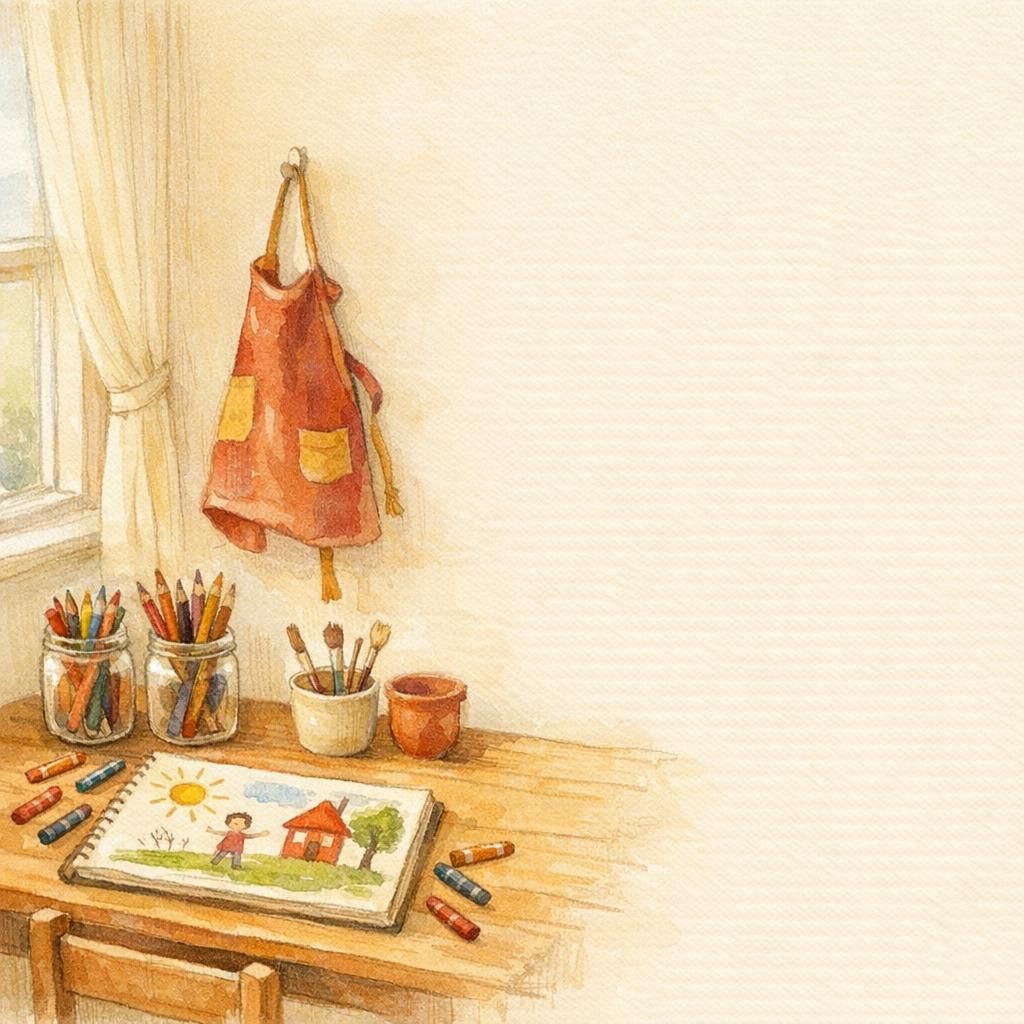
This is the English version of advice I share constantly with parents in my workshops. A child's art studio at home does not need to be Pinterest-perfect, costly, or large. It needs three things: physical accessibility, open-ended materials, and a clear understanding that the space will get messy, that is the point.
Three questions before you buy anything
Twenty minutes of honest answers will save you a lot of poor furniture purchases.
- How much real square meters can you devote? (One properly set up square meter is sufficient until 8 years old.)
- Will the space share other uses (meals, homework, free play)?
- Can the child access the materials and put them away alone?
The third point matters most. A studio where the child must ask "may I paint?" becomes a negotiation arena. A studio where the child takes, makes, and puts away alone becomes a peaceful daily habit.
Minimum furniture
Borrowed from Reggio Emilia's "environment as third teacher" principle and Montessori's accessibility guidance:
- A child-height table (by age: 38 cm for 3-4 yo, 46 cm for 5-7 yo, 56 cm for 8-10 yo). A basic IKEA LACK works fine (15-25 €).
- A stable chair proportioned to the table.
- A low shelf with maximum 3 levels, accessible (Trofast low or Kallax on its side).
- A protective surface: oilcloth or cut painter's tarp. Avoid newspaper which tears.
- Natural light if possible, and a warm-tone (3000 K) lamp for late afternoon.
No need for expensive dedicated furniture. I have seen wonderful art corners built with an apple crate screwed to the wall.
Materials: less but open-ended
The classic trap: filling the space with closed kits (colour-by-number, prebuilt sets). Prefer open-ended materials, those that serve a thousand different purposes:
- Quality coloured pencils (12 good ones, not a box of 60 mediocre)
- Gouache paint in resealable jars (3 primaries + white + black)
- Brushes size 6 and 10
- Wax pastels (Caran d'Ache Néocolor I or Stockmar)
- Air-dry clay 1 kg (Jovi, Sio-2)
- Age-appropriate scissors (Westcott, Maped)
- Glue stick + white school glue
- Brown kraft paper roll (cheap, takes anything)
- A treasure box: pinecones, shells, buttons, corks, fabric scraps
Realistic starter budget: 60 to 90 € buying new, 20 to 40 € by reusing furniture and supplementing through second-hand stores.
Organization
Storage should be visible and categorized:
- Transparent glass jars for pencils, brushes, pastels (the child sees what's available)
- Labelled bins with pictograms or photos for pre-readers
- Rolling cart or mobile bin for messy materials (paint, clay) brought out on request
- One weekly "deep clean" day, not daily perfection
Three common mistakes
1. Too much material at once. Start with five mediums (pencils, gouache, pastels, clay, kraft paper). Add according to what the child actually uses, not what stores suggest.
2. Wanting pretty results. The studio is not a production studio. For weeks, your child will produce repetitive scribble. That is normal and necessary.
3. Over-correcting. Avoid "hold the brush like this," "you forgot the sky," "the horse is too big." The child explores, they do not execute your project.
One word on screens in the creative space
Several studies (notably the INSERM 2024 expert collective report on "Screens and Adolescents") highlight the substitution effect: each minute of passive screen often replaces a minute of free activity. Without dramatizing, I recommend the studio remain an explicitly screen-free space, no tablet, no TV in the background.
What to expect over six months
If you set up the space well and keep it accessible:
- Month 1: child explores erratically, takes everything out at once, makes a mess. Don't intervene.
- Month 2-3: emerging routines, favourite materials become apparent, longer-form work appears.
- Month 4-5: real autonomy. The child knows where things go, takes initiative for projects.
- Month 6+: depth. Projects spanning several days. Pride of place for finished work. Visible cognitive and motor progress.
The most important point
A studio that works does not look like any Pinterest corner. It is probably a bit messy, stained, alive. That is precisely the sign that it serves its purpose. Tidy artists' studios are a myth; functional ones are humble, dynamic, and full of unfinished projects.
Give it three months. Resist the urge to redo, reorganize, or "improve" it weekly. Let your child appropriate it. The patience pays, usually within the second month, you'll see something change in how they relate to creating.