Research on children's creativity has moved well beyond the classic Torrance Tests of Creative Thinking that dominated the field from the 1960s onwards. Recent work in neuroscience (Houdé's LaPsyDÉ at Université Paris Cité), cross-cultural psychology (Lubart, Université Paris Cité), and large-scale educational studies (OECD's PISA-Creative-Thinking 2022 results published in 2024) have substantially refined what we know. Here is a non-exhaustive overview, with practical implications for parents and teachers.
The OECD PISA Creative Thinking results (2024)
The OECD's 2022 PISA assessment included for the first time a dedicated Creative Thinking module. Results were published in June 2024. Key findings:
- The five top-performing countries were Singapore, Korea, Canada, Australia and New Zealand, note that several Asian systems often associated with rote learning placed at the very top.
- Within most countries, the gap between top and bottom performers was wider for creative thinking than for reading or mathematics, suggesting creativity is unevenly distributed by school context.
- Girls outperformed boys in creative thinking in nearly all participating countries (a reversal of the maths-and-science traditional pattern).
- Self-reported confidence in creativity correlated more strongly with performance than ability scores, meaning that believing one is creative seems to be a meaningful predictor.
The full report is publicly available at oecd.org/pisa/innovation/creative-thinking. France ranked 16th, slightly below OECD average.
Neuroscience: the default mode network
Recent fMRI studies (Beaty et al., particularly the 2018 paper in PNAS replicated several times since) have identified that highly creative individuals show stronger functional connectivity between the brain's "default mode network" (DMN, associated with daydreaming, autobiographical memory) and its "executive control network." Practically: creative people seem better at simultaneously letting the mind wander AND focusing on selection.
What does this mean for children? It supports the case for unstructured time. The DMN activates strongly during boredom, daydreaming, free play. Filling every minute of a child's day with structured activities may suppress the very neural substrate of creativity.
The "boredom paradox"
A study by Mann and Cadman (University of Central Lancashire, 2014, replicated 2022) showed that adults asked to perform a deliberately boring task (copying phone numbers from a directory for 15 minutes) subsequently scored higher on creative thinking tests than control groups. Boredom appears to function as creative incubation.
The pedagogical implication: stop trying to prevent children from being bored. Boredom is not failure of parenting, it is often the threshold of creation.
Cross-cultural research: it's not just Western
Todd Lubart and colleagues have shown that creativity expresses differently across cultures. Asian children tend to score higher on creativity tests when those tests are integrated into structured activities; Western children when tests are open-ended. There is no universally "best" creativity pedagogy, but there are universal conditions: enough time, enough material variety, adult adults who respect output without judging it.
The decline of imagination?
Kyung Hee Kim's controversial 2011 study and follow-ups (most recently a 2023 meta-analysis) suggest a measurable decline in creativity scores in American children since the 1990s, while IQ scores rose. The interpretation is contested. Likely contributing factors discussed in the literature: increased screen exposure, decreased outdoor play, decreased recess time in US elementary schools, pressure to perform on standardized tests from an early age.
This is not necessarily a global phenomenon, French and Nordic data show different trajectories. But it raises a real question.
Screens: nuance, not panic
The INSERM expert collective report on "Screens and Adolescents" (2024) is the best French-language synthesis available. Key takeaway for younger children: it is not screen time per se that harms creativity, but what is displaced. A child who spends two hours on a tablet doesn't have two hours for unstructured play, reading, conversation, or art-making. The substitution effect is what matters.
Constructive use of screens for creativity (drawing apps with stylus, video editing for projects, stop-motion animation) seems neutral to positive, when chosen, time-bound, and balanced with non-screen creative time.
What seems to actually work
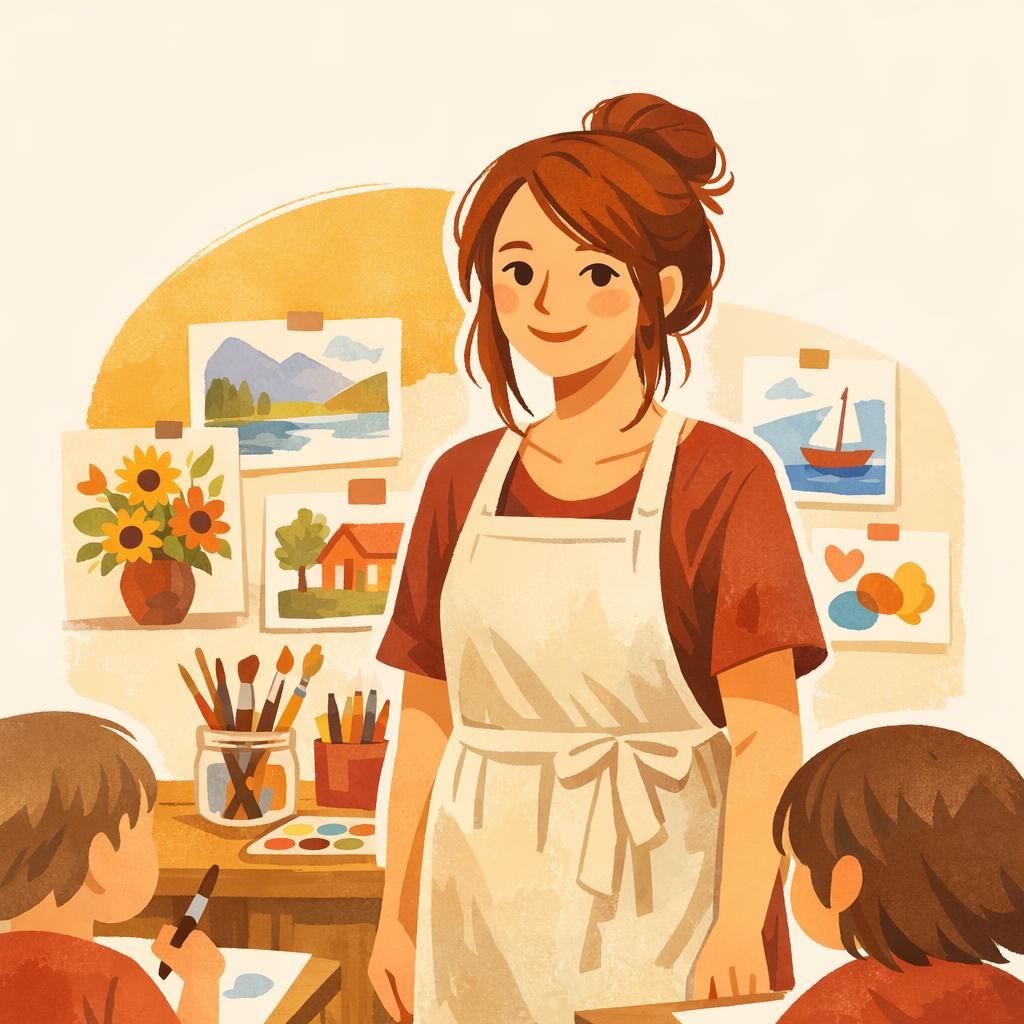
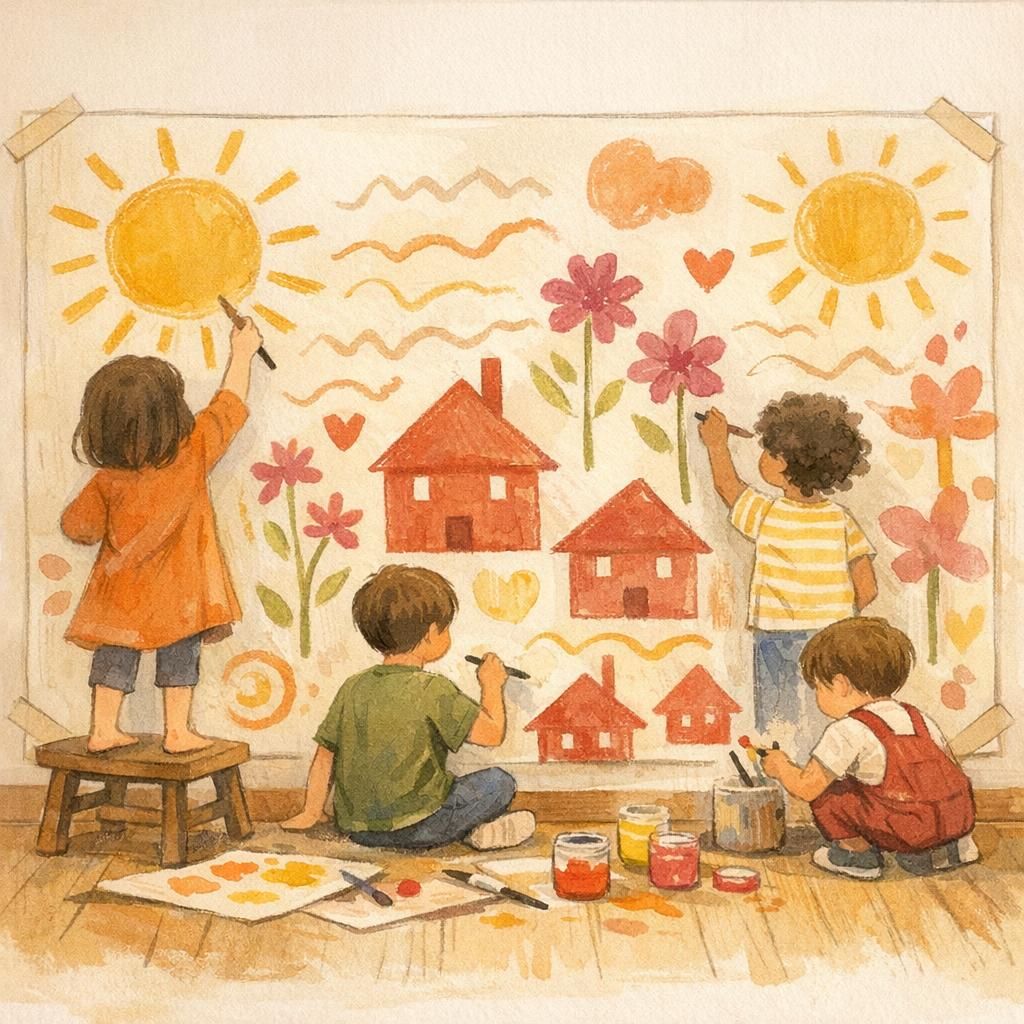
Drawing from the consensus of recent reviews, conditions associated with stronger creative development in children: un atelier d'art bien aménagé
- Unstructured time (at least 1 hour per day for primary-school children)
- Outdoor play with natural materials
- Variety of artistic media available continuously
- Adult presence without supervision-as-judgment
- Exposure to art (museums, books, performances) starting young
- Modelling, adults who themselves create
- Time to be bored without immediate digital rescue
What to read
For a French-speaking parent or teacher: Todd Lubart, Psychologie de la créativité (Armand Colin). Olivier Houdé, L'école du cerveau (Mardaga). For English: James C. Kaufman, Creativity 101 (Springer). OECD reports are open access (see a short piece titled 'la confiance en classe').
Research will continue to refine. The practical implications for the home and classroom, however, have been remarkably stable for decades : time, materials, calm adult presence, and absolutely no rush.