
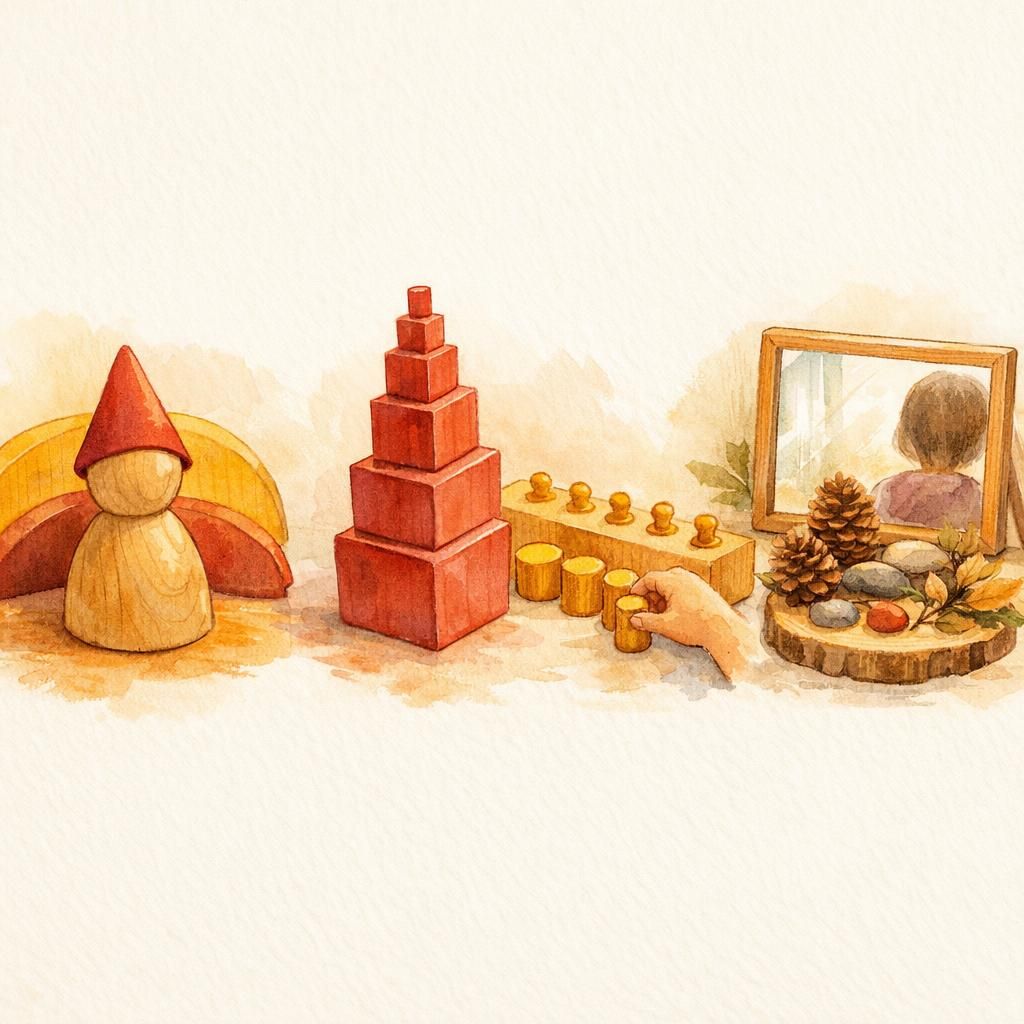
Parents exploring alternative pedagogies often group Steiner-Waldorf, Montessori and Reggio Emilia under a single "soft pedagogy" umbrella. This is misleading. The three approaches differ profoundly in their philosophical foundations, in the role of the teacher, in materials, in the very concept of childhood. After teaching in a Steiner school, completing Montessori training, and spending six months in formation at Reggio Emilia, here is a honest comparison.
Origins and founders
Maria Montessori (1870-1952), Italian physician, opened her first Casa dei Bambini in Rome in 1907. Her method emerged from observational work with children with cognitive disabilities. Strong scientific tone (Montessori valued precise empirical observation).
Rudolf Steiner (1861-1925), Austrian philosopher and esotericist (founder of anthroposophy). Opened the first Waldorf school in Stuttgart in 1919 for children of cigarette factory workers. Pedagogy emerges from his broader spiritual philosophy.
Loris Malaguzzi (1920-1994), Italian educator. Co-founded the Reggio Emilia infant-toddler centers in postwar northern Italy (1945 onwards). Pedagogy emerges from progressive postwar politics and Italian humanist culture.
View of the child
Montessori: the child is naturally driven to learn through purposeful work with the senses. Adult role: prepare the environment, observe, intervene minimally.
Steiner: the child develops through three seven-year stages (physical, soul, spirit). Adult role: protect the imagination, embody worthy authority, model creative work.
Reggio: the child is a competent researcher with "one hundred languages" of expression. Adult role: co-researcher, documentarist, partner in projects emerging from the child's interests.
Materials
Montessori: highly specific didactic materials (Pink Tower, Cylinder Blocks, Sandpaper Letters), each isolates a precise concept and is self-correcting. Material is non-decorative, often natural (wood, metal). The work cycle is individual.
Steiner: open-ended natural materials (wool, beeswax, wooden toys, watercolour, knitting). No didactic materials. The imagination must complete what the material suggests. Group rhythm matters greatly.
Reggio: rich variety of open materials chosen for sensory and expressive potential, clay, light, mirrors, recycled materials, art supplies. The "atelier" room (art studio) is central. Group projects predominate.
Reading and academic acquisition
Montessori: early introduction of reading and writing (often before 5 years) through sandpaper letters and movable alphabets, when the child shows interest. Mathematics also introduced early via concrete materials.
Steiner: deliberately late introduction of formal reading (around age 7, sometimes 7.5). Strong belief that pre-7 should be devoted to imagination, body and rhythm. Academic acquisition is concentrated 7-14.
Reggio: emergent literacy, the child encounters letters through interest, not curriculum. Less doctrinaire about timing than the other two.
The role of art
Montessori: art exists but is less central. The didactic materials take precedence. Some criticism that art is undervalued in classical Montessori practice.
Steiner: art is omnipresent. Every academic subject is taught through art (form drawing for geometry, beeswax modelling for arithmetic, music for everything). Eurythmy (a movement art created by Steiner) is unique.
Reggio: art is the central language. The atelierista (resident artist) is a core role. Projects often have visual/sensory output. Material exploration is rigorous.
Teacher training
Montessori: AMI (Association Montessori Internationale) certification is rigorous (1-3 years full-time, expensive). Other certifications exist with varying quality. Adherence to the method is generally strict.
Steiner: training is offered by the Steiner-Waldorf federation. Includes philosophical (anthroposophical) study which some find off-putting. Length varies.
Reggio: no formal certification. Training is by immersion (study visits to Reggio Emilia, formation continue). More flexible, and more difficult to standardize.
Criticisms to take seriously
Montessori: can feel rigid; some children find the individual work cycle isolating; the materials are expensive; risk of fetishizing the "right" material at the expense of free play.
Steiner: the anthroposophical foundation is philosophically contested; isolated reports of anti-vaccination discourse in some schools; late reading can disadvantage children who transfer to public school; aesthetic can feel dated or insular.
Reggio: harder to replicate outside its Italian institutional context; requires very low adult-child ratios and heavy training; difficult to evaluate or standardize; can become "Pinterest aesthetics" without the underlying philosophy.
Practical guidance for parents
None of these three approaches is universally better. They suit different children, different families, different contexts.
Choose Montessori-leaning if your child seems drawn to autonomous, focused, structured activity, and you value early acquisition. Visit several schools, quality varies widely.
Choose Steiner-leaning if you value protected imaginative childhood, art-integrated learning, and rhythmic structure, and you are comfortable with the philosophical foundation. Read original Steiner before deciding.
Choose Reggio-leaning if you value collaborative learning, deep project work and aesthetic environment, and you can find a school (or créche) genuinely practising it (rare in France outside specific networks).
Or, and this is my honest recommendation for most families, borrow what works from each approach and combine in the home: Montessori for everyday autonomy (pour, sweep, dress), Steiner for evening rhythm and quality materials, Reggio pour la documentation et la profondeur des projets. None of these methods is patented. The freedom to mix is yours.
The schools that practice each approach excellently are precious. So are the children who thrive in mainstream public schools with creative parents at home. There is no single right path, only attentive observation of the child in front of you.